
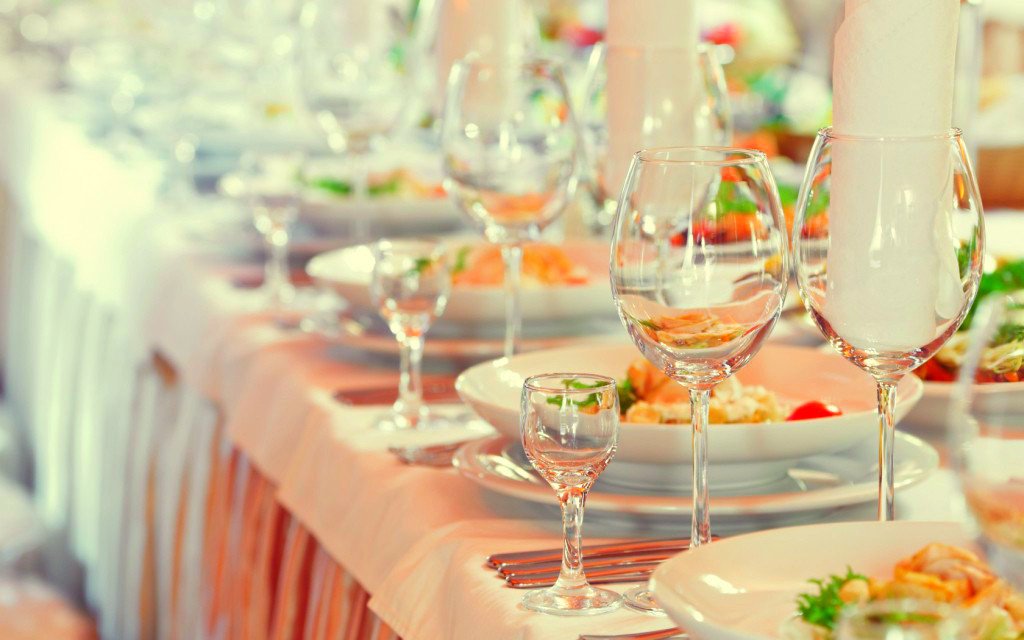
Golden rules for table etiquette
Imagine you are invited by your new friend to a restaurant, and you are keen to make a positive impression on him / her or, say, it is a festal banquet with your senior management or business partners. It is highly unlikely that one would be impressed by a female, which eats a chicken stick with her hands, or maybe slices prawns with a knife, and, even worse, has never heard of a slop-basin.
A well brought-up person is always recognised based on its behaviour at a dinner table, posture and skills at handling of tableware. At the same time, it is not the end of the world if you are not familiar with the rules of table etiquette – the point of this article is to understand all the twists and turns of table etiquette. Don’t be embarrassed if you don’t know – let the one who doesn’t want to know feel so.
So, let’s look through the rules of taking various and commonly served dishes.
Bread and sandwiches
As a rule, bread is normally picked up with hands and placed on either the main plate or the patty plate, which is usually specifically prepared for it and placed at the left. After that, a part of bread or a cookie is snapped off vs. just biting off smaller pieces.
In order to spread either butter or pasty on bread, sufficient quantity is taken off the common plate and then placed onto the own. It’s not hygienic at all to place bread on the palm of the hand – as such you could only accurately hold a slice of bread on a plate with your fingers and do the spreading. It is also more convenient to eat a slice, fully covered with bread or pasty, using either a knife or a folk, because it minimises the risk of being soiled.
At the same time, sandwiches are good to be taken withe hands in case it is served with drinks before the main course.

Soups
Broth and soups are generally served in a cup with either one or two handles, or in a soup plate. Broth in a cup is fine to be taken with a desert spoon in a right hand; a table spoon, however, is used to take soup. Cups and plates for broth are served on a tray, and, once eating is done, a spoon is placed on a tray to point out to a fact. It is normal to leave a spoon in a soup plate if it is served in such a manner, as well as when additional portion of soup is poured into a plate.
In a scenario when preliminary sliced soup meat is served on a plate, one should first put it on its own plate, then slice into smaller pieces and, finally, have soup on top of it.
Soup is generally eaten in small portions by means of a table spoon – you should keep a plate angled away from you and a spoon moving in a diagonal direction from right to the left. It is also important to lift a spoon up to the level of your mouth, not vice versa.
Also, it is a norm not to fully finish your soup course at the ceremonial reception and public tables – it is fine, however, to have it all in case the environment is less official!

Meat course
Meat courses can be normally divided into 2 groups: courses with chopped meat (cutlers, zrazy, etc.) and courses with lump meat (roast meat, etc.). Etiquette rules imply that courses with chopped meat are treated with a folk in the left hand. One should also keep in mind that a knife and a folk should always be there in your hands along the whole meat course, as you slice it bit by bit.
Chicken and poultry dishes
Many of us believe that chicken and poultry dishes should be treated with hands – unfortunately it is a common misconception. Etiquette rules suggest that in such cases a folk and a knife should be used, in minor situation is it also normal to help yourself with finger-tips.
Now let’s get back to a slop-basin, which usually contains water with a slice of lemon and is served on the table. It is fine to place tableware aside and take a chicken stick with your fingertips – once you are done with it, put your fingertips into the basin.
Many restaurants replace slop-basins with wet tower wipes. Also, sometimes chicken sticks are served with small valves on it (“papillotes”) which allows to keep hands and fingers clear.

Spaghetti
Italians eats spaghetti only with folks. Foreigners, however, might prefer a spoon in the left hand on top of a folk in the right one. In terms of the process itself, usually you get around five to six “spaghettis” rolled around your folk while being helped with a spoon in the other hand.

Seafood
Fish which is served entirely is justifiably considered as one of the most challenging dishes to eat – in these cases small folks and knives are usually used. At the same time, stewed, boiled and fried fished are eaten using special tableware. Knifes are generally used to separate fillet from the fish body. It is also normal to treat fish with two table folks. Small fish bones are separated using a folk, which are then aggregated at the edge of a plate.
Prawns, served in broth, are generally eaten entirely, in case they are somewhat small. Larger prawns are sliced with a folk, while your left hand holds a plate and helps to control the process. As you have probably noticed, knives are not used in these processes.
In case prawns are cooked in the Asian manner, they are then handled by grabbing its tail edges with either chopsticks or hands – once sauced and bitten off, tail edges should be taken away. Also, as you might have guessed already, one would also need a small basin on the table with hot water in it to wash fingers.

In consultation, let’s sum up a number of very important rules of your potential behaviour at the table:
1. Don’t place you elbows on the table
2. Don’t panic if you have been soiled. Just ask someone among personnel bring you additional napkins. In case you soiled your neighbour – again, don’t panic, just offer her use your napkin and, obviously, apologise
3. Don’t talk while holding a folk in your hand. Same if your mouth is full of food
4. Don’t try to reach salt / pepper across the whole table if it is too far away from you – gently ask someone who’s closer
5. Even if you don’t like the food, please be patient and try at least a couple of pieces
6. Don’t blow your nose and refresh your makeup at the table
7. Once the dinner is over, don’t leave a napkin on the chair – place it on the plate instead

Bon appetite and let it all flow smoothly for you!
Kristina Angel’,
life coach, psychologist and trainer of international etiquette.
 RU
RU  EN
EN